Every December, the games industry publishes prediction posts waxing poetic about the year to come. And, frankly, most of them are wrong. The ones that aren't are usually obvious ("AI will keep growing!" "Live service matters!").
This isn't one of those posts.
2026 is the year mobile gaming breaks out of its old playbook. Fees, funnels, discovery, and monetization are shifting under everyone’s feet and the studios that adapt fastest will rewrite their economics.
Here's what we're watching.
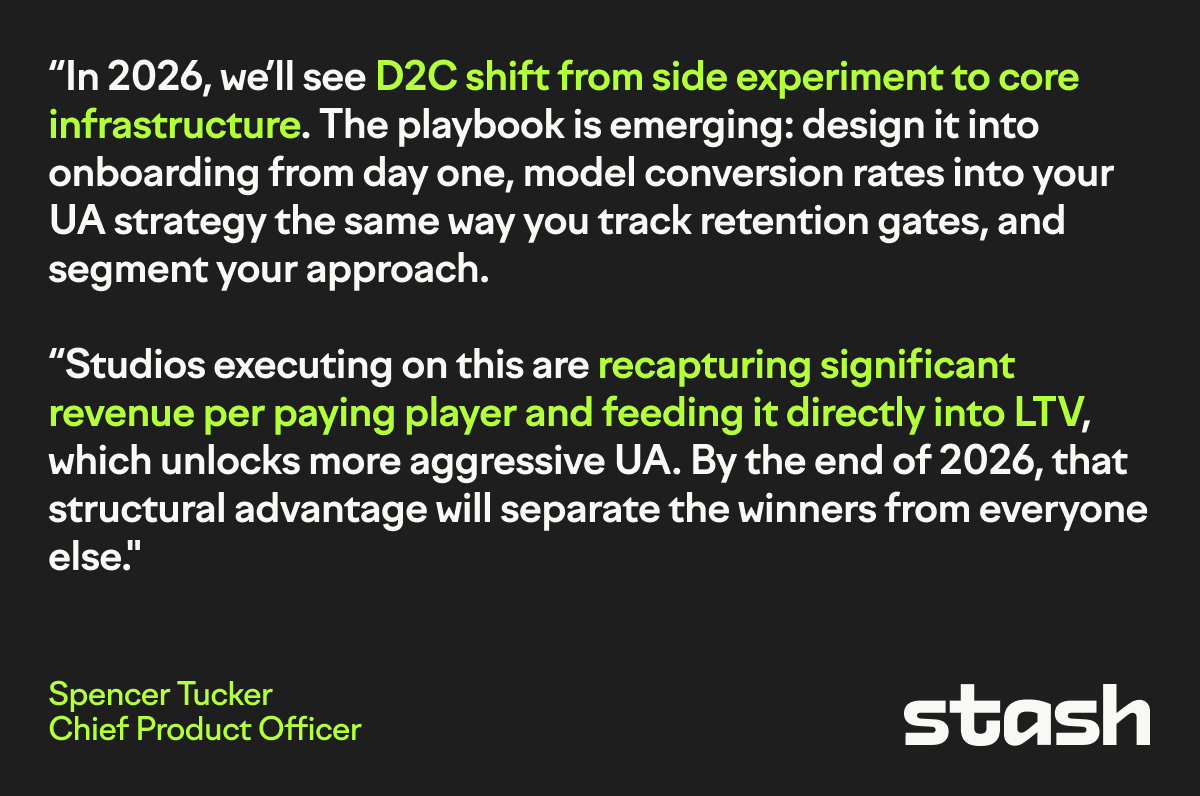
Prediction 1: D2C Becomes a Growth Lever, Not Just a Margin Play
Today, most studios treat D2C like a nice-to-have: "Let's build a webshop for whales and capture some extra margin."
That's leaving the real win on the table.
The unlock: If you can systematically move players onto D2C rails early and keep them there, you don't just save 30% on fees. You fundamentally change your unit economics.
Here's the math:
- Player installs your game
- Onboarding naturally introduces D2C as the default way to spend
- 60-70% of their lifetime spend happens off-store
- You recapture $15-$20 per paying player that would've gone to platforms
- That flows directly into LTV
- Higher LTV = you can bid more aggressively on UA
- Higher UA spend = faster growth
The playbook we're seeing emerge:
- Design D2C into onboarding from day one. Not as a side flow—as the flow. Make it feel native. Make it feel obvious.
- Model D2C conversion into your UA strategy. Track what % of new installs convert to D2C. Measure the LTV lift. Feed it back into your bidding logic. Treat it like you would retention or monetization gates.
- Segment and personalize. Whales get high-ticket webshop offers. Mid-spenders get cart incentives. Cosmetics buyers get bundles. One-size-fits-all is dead.
By the end of 2026, the studios winning at UA won't just have better creative or better targeting. They'll have structurally better economics because they own more of the transaction.
Prediction 2: Alternative Distribution Stops Being "Alternative"
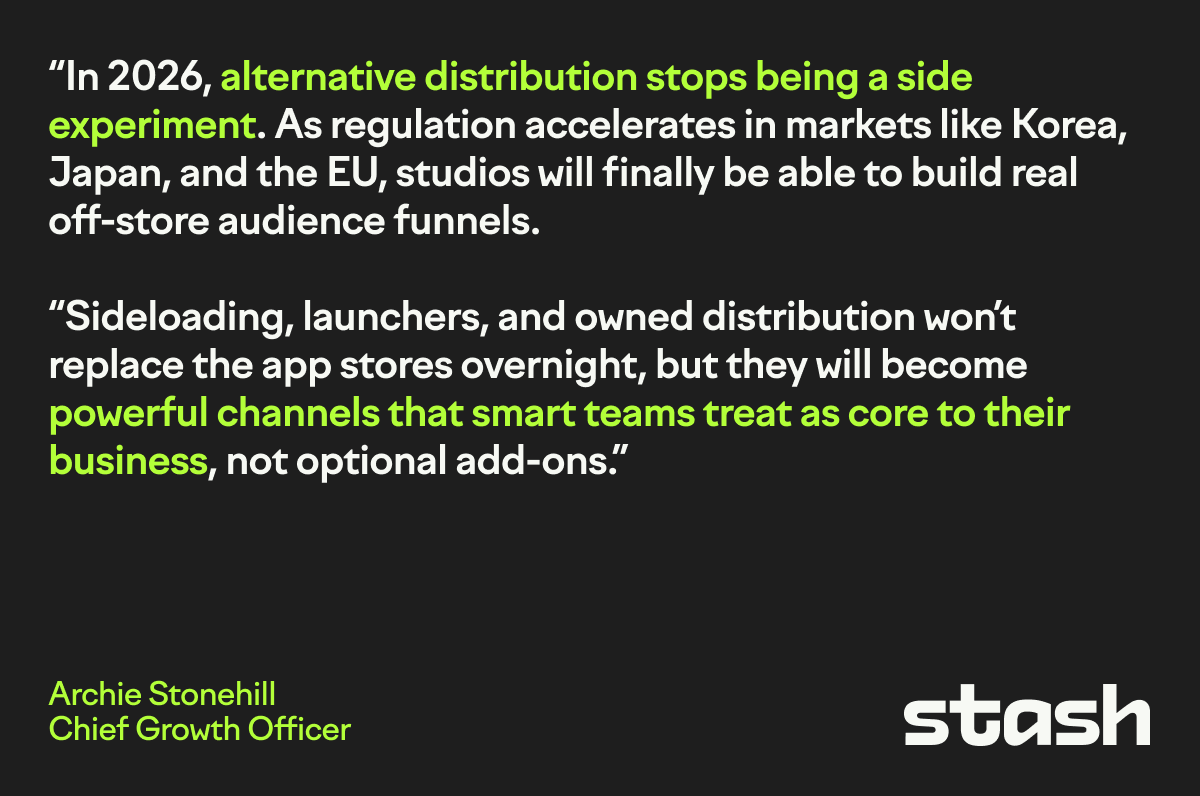
Here's what everyone knows: alternative payments are opening up. Webshops work. Link-outs work. D2C monetization is real.
Here's what's less obvious: alternative distribution is about to catch up.
Between EU rulings, regulatory pressure in Korea and Japan, and sideloading momentum on Android, the walled gardens are cracking. Not everywhere. Not overnight. But enough that it matters.
What this looks like in practice:
- Sideloading goes mainstream in key markets. Players in Seoul, Tokyo, and São Paulo increasingly discover games through APK ecosystems, not app stores.
- Launchers become real distribution channels. On PC, studios already run their own hubs—think Riot, Battle.net, Epic. That model starts working on mobile in select geos.
- D2C and distribution converge. You're not just running a webshop anymore—you're running a full stack: payments, content delivery, social systems, and storefronts in one place.
The result is a more fragmented landscape, but also a more flexible one. Studios can't just ship to the App Store and Google Play and call it done. But they also don't have to accept platform fees as destiny.
Bonus Prediction: Mobile Games Will Keep Stealing from PC
Zoom out from D2C for a second.
One of the most interesting creative trends we're seeing as gamers ourselves: PC/console aesthetics and mechanics bleeding into mobile, fast.
You've already seen it:
- Free-to-play mobile battlers that look suspiciously like Cuphead
- Post-apocalyptic tribal sci-fi worlds that feel very familiar
- Extraction shooters, roguelites, and bullet hells reimagined for touch controls
Sometimes it's official licensing. Sometimes it's "heavy inspiration." Either way, the pattern is undeniable:
- Aesthetics from PC indies (distinctive art styles, character design, worldbuilding) get ported into mobile F2P.
- Mechanics from AAA hits (boss-rush loops, stamina systems, exploration beats) get translated into session-based formats.
- Player expectations rise. Mobile players increasingly expect PC-level production, even in free-to-play titles.
Chinese and other Asian developers are leading this charge and Western studios are following fast.
The twist: Eventually, this inspiration loops back the other way. Mobile-first mechanics start influencing PC and console design. But we're not there yet. For now, the flow is one direction, and it's accelerating.
What This Means for Forward-Thinking Studios
If you're planning for 2026, all of these trends point the same direction:
- Own more of your relationship with the player.
- Wire D2C into your business model, not just your menus.
- Treat alternative distribution as strategic, not tactical.
- Build worlds and mechanics that can live across platforms.
The studios that move early will have structural advantages: more margin to reinvest, more control over distribution, and more room to experiment with the high-quality experiences players already expect from the best PC and console titles.
Let's talk. If you're thinking about your D2C strategy for 2026, we should chat. We work with studios on native payments, webshops, launchers, and the infrastructure that transforms gaming P&Ls.