TL;DR
On June 24, Google announced “expanded billing choice and lower fees on Google Play,” rolling out from June 30 “beginning with the United States, the EEA, and the UK.” Most coverage is running with the “lower fees” headline. That framing is doing a lot of work for Google.
Two things are happening at once, and Google is being careful not to separate them:
- Some fees genuinely come down. The service fee starts at 10% on your first $1M of annual earnings and 10% on all auto-renewing subscriptions, with the 5% billing fee now broken out separately. Real, and good for smaller devs and subscription apps.
- The bigger move is an attempted crackdown on DTC, dressed as “choice.” Google is using the new “service fee” architecture to assert a right to tax link-outs and external web purchases: the same channels the US courts forced open at 0%. The service fee / billing fee split has been a long-time goal of Google, since it applies “regardless of whether you use Google Play’s billing, alternative billing, or external web links.” However, it remains to be seen whether regulators will accept this expansion of Play’s monetization scope.
The part you most need to understand (and which most coverage misses): in the US, Google is under a court-ordered injunction that prohibits it from interfering with link-out purchase flows**.** As such, it is highly unlikely that Google can apply this fee in the USA. That is what we’re hearing from developers’ direct discussions with Google and it is why Google’s own US program page lays out a full link-out fee schedule and, in the same breath, says it is “not assessing these fees.” That tells you everything.
Bottom line for US Android: do nothing. Keep your zero-fee direct link-outs exactly as they are. Do not preemptively comply with a fee Google is not legally able to charge.
1. What Google actually announced
The headline changes (eventually global, rolling out from June 30 in the US (maybe), EEA and UK first):
- Service fee and billing fee split attempts to crack down on DTC. The old bundled 30% cut is now a “service fee” (for distribution via Play) plus a separate “billing fee” (5% in the US/UK/EEA) that only applies if you use Google Play Billing. Use your own billing or a web link and you skip the 5%.
- 10% on the first $1M, then 20% service + 5% billing. Service fee starts at 10% on your first $1M (USD) of annual earnings, and 10% on all auto-renewing subscriptions. For most IAPs, it generally will mean that developers are now paying 25% rather than 30% - a major boon for the industry.
- Substantive policy changes giving developers more freedom (including billing choice, removal of anti-steering provisions, confirmation of webview compliance for link-outs). A series of substantive policy changes now genuinely give developers more freedom in how they take payments, even though the incentive is reduced. This is a genuine win and clarifies a few contentious elements of DTC UI/UX design (e.g., freedom of messaging about web stores, link out payments served via a web view).
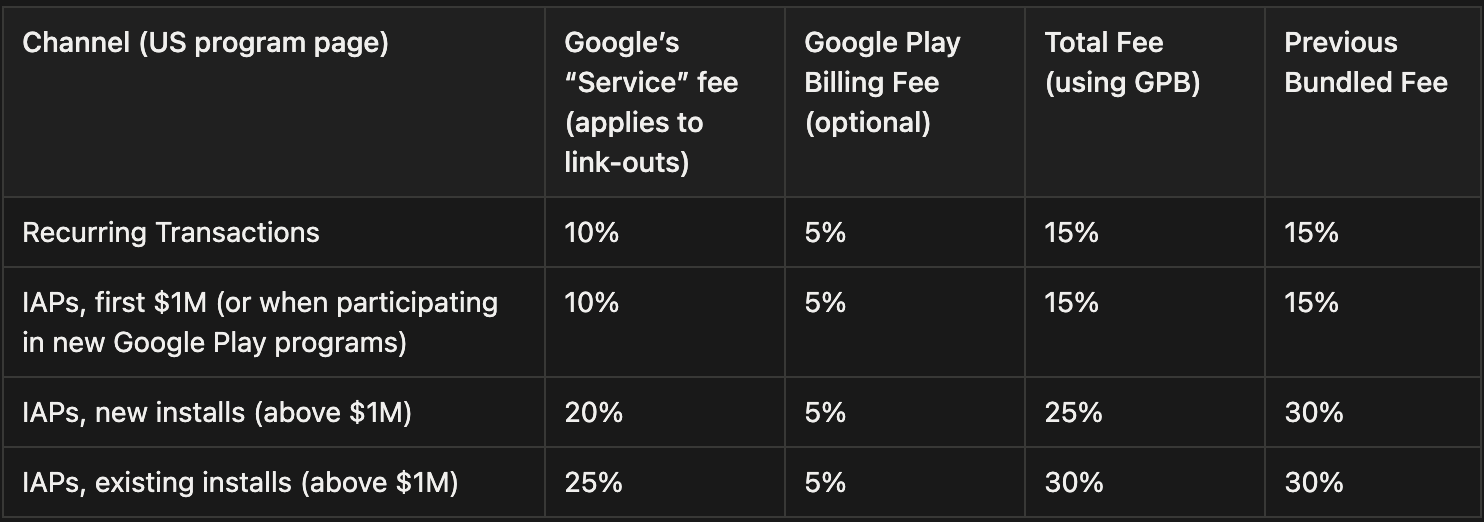
This policy change is, generally, a response to the massive growth in DTC the games industry has seen over the last 4 years. It attempts to both reduce the incentive for developers to offer DTC channels with a modest 5% fee reduction and attempts to expand the scope of Google’s fee into off-platform transactions that users access via in-game links.
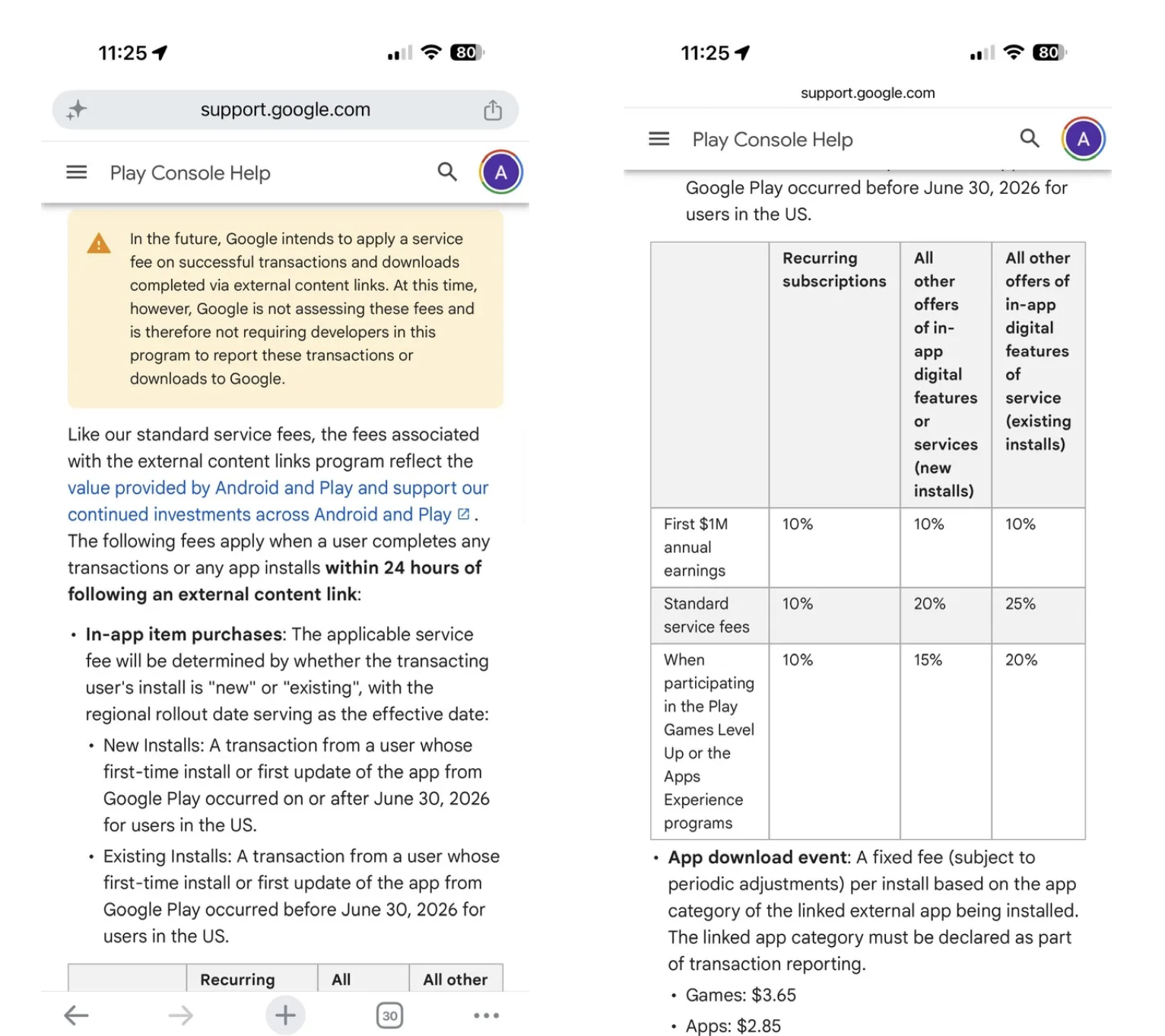
The service fee on link-outs applies, per Google, to “any transactions or any app installs within 24 hours of following an external content link.” In other words, Google is claiming a cut of purchases that happen on your own website after a user taps out of the app.
This is exactly what I flagged in my March and April updates and Linkedin post following the policy announcement. The shape hasn’t changed: anti-steering is gone, link-outs are permitted, and Google is trying to tax them. June is Google formalizing the fee machinery and, importantly, trying to fold the US into the same rollout.
2. The US sleight of hand
Read Google’s announcement and you’d reasonably conclude a fee is coming to your US link-outs on June 30. It isn’t, and it can’t, and Google knows it.
The US sits under a permanent injunction from Epic v. Google (Judge James Donato, N.D. Cal., Case No. 3:20-cv-05671-JD). The original 2024 order was upheld on appeal and the Supreme Court declined to disturb it. Under that injunction, Google may not require Google Play Billing, may not stop you steering users to outside purchase options, and may not “prohibit the use of in-app purchase methods other than Google Play Billing” or “prohibit developers from communicating with users about the availability of a pament method other than Google Play Billing.” Google’s own US policy page confirms these freedoms have been in force since October 2025.
Now, technically there is no explicit mention of Google’s ability to charge fees on linked-out purchases. As such, it is possible that Google could adopt an aggressive interpretation of this injunction and attempt to push ahead with its new pricing model. However, the injunction’s provisions that prevent Google from prohibiting developers from “communicating with users about the availability of a payment method other than” GBP is generally read as preventing the kind of entitlement program Google is pushing with its new policies.
.png)
Now look at Google’s US “external content links program” page. Two things appear on the same page:
- A complete fee schedule for link-outs (the 10% / 20% and $2.85-$3.65 figures above).
- This line: “In the future, Google intends to apply a service fee on successful transactions and downloads completed via external content links. At this time, however, Google is not assessing these fees and is therefore not requiring developers in this program to report these transactions or downloads to Google.”
And the program’s availability is explicitly pinned to the court: “This program is available in the US in connection with the US District Court’s order. Google reserves the right to modify or terminate this program… as a result of any changes to or termination of the US District Court’s order.”
That is not the language of a company that can charge this fee. It’s a company publishing the price list it would like to charge, while conceding it currently can’t. Publishing a US fee schedule next to “we’re not charging it” is not transparency: it’s pre-positioning and intimidation, and it manufactures exactly the confusion that gets developers to restructure their flows early.
What I’m hearing privately from developers who’ve raised this with Google lines up with my read: Google is not planning to switch on the US fee, and acknowledges it cannot do so without the judge’s sign-off. I’d treat that as encouraging but not a guarantee (more on that below).
3. What this means for you
US (Android): no changes. Keep your direct link-outs.
The injunction holds. Zero-fee direct link-outs and alternative billing continue. You do not need to remove your US link-outs, and I’d strongly advise against doing so, until and unless Judge Donato rules that Google may charge. Acting now means voluntarily giving up a zero-fee channel that the court is currently protecting for you, on the strength of a price list Google itself says is not in effect.
If you take one thing from this: don’t let a confusing announcement push you into “compliance” with a fee that doesn’t legally exist yet.
UK and EU: the fee structure - and external link entitlement requirement - will likely apply for now, with caveats.
Outside the US, Google isn’t under the Donato injunction, so the new service fee on external links will most likely take effect (the UK and EEA are in the first rollout wave). For most of you this is less dramatic than it sounds: US-style zero-fee direct link-outs weren’t available in these markets anyway. The EEA runs through the External Offers Program and alternative billing, which already carry fees, so this is more continuity than a new tax.
Two things to watch:
- Webshop onboarding flows. Where you link from inside the app to a web store in the UK/EU, the service fee on external links can hit those economics and I anticipate Google will start cracking down on these flows. Worth modeling before you lean on in-app web links as the primary onboarding path there, and obtaining other out-of-app communication channels with your player base ASAP.
- Regulators are not done. The UK’s CMA (now armed with new powers over Google’s mobile platform under its digital markets regime) and the European Commission under the DMA will both scrutinize whether a fee on external links is permissible. These rates are not settled law; they’re Google’s opening position. Don’t assume today’s numbers are permanent in either market.
Out-of-app DTC stays untaxed everywhere.
None of this touches out-of-app acquisition: email, social, community, web. Those channels remain at roughly all-in payment cost (~5%) regardless of region or court outcome, and structurally beat any Play channel. The in-app link-out is a powerful top-of-funnel tool, but the core DTC economics live outside the app.
.png)
4. The honest caveat
I’ll be straight about the limits of my own read. This US fee schedule looks to me clearly non-compliant with the standing injunction. But “non-compliant” and “won’t happen” are not the same thing. Whether Google actually respects the order depends in part on developers noticing, pushing back, and if necessary being willing to litigate. Platforms have rolled out aggressive interpretations before and dared the ecosystem to challenge them.
So: I’m confident enough in this read to tell you not to change your US flows, and the private signals (Google saying it won’t switch the fee on without the court) reinforce that. But stay alert, and don’t assume the question is closed.
5. What’s next
The decisive event is the evidentiary hearing on July 16, 2026 before Judge Donato in San Francisco: the “final act,” in his words, on whether to approve Google and Epic’s revised settlement (which would let Google charge a distribution fee on link-outs) or keep the original injunction in force. He has been openly skeptical of the settlement and whether it serves the public interest, not just Epic and Google.
I’ll be at the hearing and posting updates live. Follow Stash for the real-time read on what it means for your Android DTC strategy.
Reach out with any questions: happy to model your link-out economics by market.